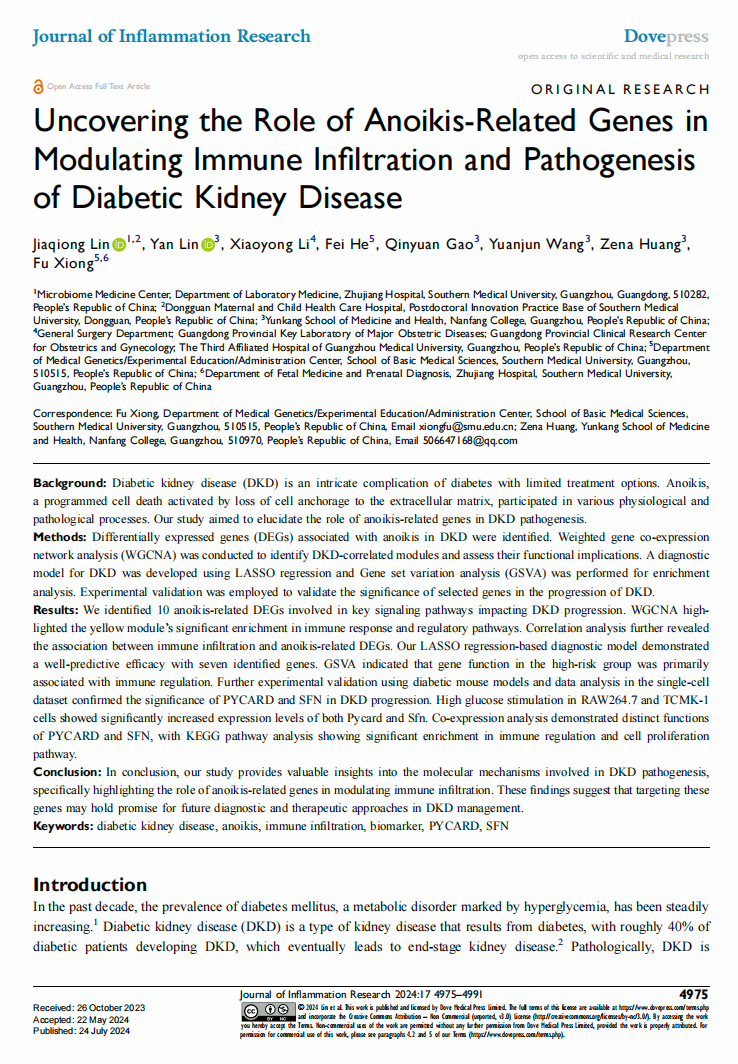
黄泽娜教授在刊物《J Inflamm Res》(JCR分区:Q2,IF=4.2)发表“Uncovering the Role of Anoikis-Related Genes in Modulating Immune Infiltration and Pathogenesis of Diabetic Kidney Disease”论文。
Abstract
Background: Diabetic nephropathy (DN) is one of the primary causes of end-stage renal disease, yet effective therapeutic targets remain elusive. This study aims to identify novel diagnostic biomarkers and potential therapeutic candidates for DN.
Methods: Differentially expressed genes (DEGs) in GSE96804 and GSE142025 were identified and functional enrichment analysis was performed. Diagnostic biomarkers were selected using machine learning algorithms and evaluated by Receiver Operating Characteristic analysis. c-Fos expression was validated in an established DN mouse model. Immune infiltration levels were assessed with Single-Sample Gene Set Enrichment Analysis. Co-expression analysis revealed regulatory relationships involving FOS. MAP predicted potential therapeutic candidates. Transcriptome sequencing and experiments in RAW264.7 cells was performed to investigate molecular mechanisms of emetine.
Results: In both datasets, we identified 44 upregulated and 74 downreg ulated DEGs involved in focal adhesion, ECM-receptorinteraction, and the PI3K-Akt signaling pathway. FOS emerged as a robust diagnostic marker with decreased expression in DNpatients and DN mouse. Co-expression analysis revealed potential regulatory mechanisms of FOS, implicating the MAPK signaling pathway, regulation of cell proliferation and apoptotic signaling pathways. Immune dysregulation was observed in DN patients.Notably, emetine was identified as a potential ther apeutic cand idate. Transeriptome sequencing and experimental val idation demon-strated emetine suppressed M1 macrophage polarization by inhibiting the activation of NF-kB signaling pathway, as well as reducing the expression of II-18 and Ccl5.
Conclusion: In conclusion, our study identified FOS as a promising diagnostic biomarker and emetine as a potential therapeutic candidate for DN. These findings enhance our understanding of DN pathogenesis and present novel prospects for therapeutic strategies.
Keywords: diabetic nephropathy, diagnostic markers, FOS, emetine, immune infiltration, inflammation